Movement One — Heritage Point
At Heritage Point, Gus Vasilakis sat alone, empty chairs beside him, looking down the Anclote River and waiting for the Aegean Sounding to return from the Gulf.
He had known the river since boyhood. Some things along its banks were as familiar as ever; others had changed so gradually that he sometimes noticed only when he went looking for what used to be there.
It was mid-October, and while most sponge boats would continue working the Gulf, The Sounding was returning from her final trip of the season.
Gus had known for some time that she would need to be hauled out.
On an earlier trip, Gus had noticed places on the wooden hull that deserved closer inspection. He wanted the boat out of the water before another season began.
Gus had arranged for the Sounding to be hauled out at a boatyard farther north along the Gulf Coast.
The yard expected the haul-out to take about three weeks. Once the hull was inspected, Gus would know how much work was needed.
Gus had anticipated the repairs. He preferred to take care of a working boat before a manageable repair became a much longer haul-out.
He had gradually left more of the offshore trips to Captain Mike and Poyraz. They were capable men . H e trusted them.
Still, there were things about The Sounding that Gus knew from years of working aboard her. Things he noticed before anyone thought to ask.
He watched a boat shift against its lines on the opposite bank. The river had taught him to notice small changes.
Gus took a sip of his black coffee and continued watching the river.
Nearby stood the St. Nicholas historical marker, a large brown sign with gold lettering and a gold border, mounted on a pole. It commemorated the St. Nicholas Boat Line, established in 1924 , offering river cruises and sponge-diving exhibitions. Besides it were two boats representing Tarpon Springs' sponge-diving tradition. One offered tours featuring the helmet and suit used in traditional sponge diving. The other was a modern working sponge boat. Both shared the same hull design.
Older men gathered at Heritage Point from time to time. They talked about boats, the river, the docks, and people who had worked them. Gus knew most of them and at times joined the conversations.
This morning he was alone.
The wind had been blowing steadily for days. On many of the b e rthed sponge boats, Greek and Diver Down flags stretched out westward, snapping without letup.
Gus watched the boats move in their slips. As the wind and outgoing current pushed westward, their mooring lines drew taut, then slackened as the boats shifted back and forth.
Movement Two — The Old Greek Neighborhood
Earlier that morning, Gus had walked from his home through the old Greek neighborhood of Tarpon Springs, following brick-paved Cross Street as it sloped gently downhill toward Athens Street.
At the corner of Cross and Athens stood another historical marker identifying the neighborhood as a historic district designated by the City of Tarpon Springs. Visitors sometimes stopped to read it.
Gus knew the designation, but he seldom thought of the neighborhood in those terms.
It was home to him.
Modest houses stood along the narrow streets, with small yards and familiar porches. Generations of Greek families had lived here, many connected in one way or another to the sponge boats, restaurants, shops, and businesses along the Anclote River.
Some houses had changed hands. Others had been renovated. New residents had arrived, and familiar faces were gone .
But much of the neighborhood still looked as Gus remembered it.
It was where people lived. Where families raised their children. Where neighbors knew one another. Where men returned after days or weeks working on the Gulf.
These were streets Gus had known all his life.
He had stopped for black coffee at the market before continuing along Athens Street.
It was the route he preferred when he walked to the Sponge Docks. From Athens Street, he would reach Dodecanese Boulevard at Heritage Point .
Movement Three — The Working Waterfront
Now at Heritage Point, Gus turned his attention to the working waterfront.
He walked slowly west along the docks.
The waterfront opened before him.
Working sponge boats lined the river's edge. Across Dodecanese Boulevard, shops and restaurants faced the waterfront. A few early visitors walked along the docks, looking at the boats.
The October morning was comfortable after the long, hot summer. Wind tugged at loose clothing along the docks.
Most of the sponge boats were home. They lined the working docks, some tied abreast, two deep, moving against their lines in the wind and restless water.
He passed one boat with its center hatch raised. Captain Andrew stood with his back to the dock, working at the opening. Several containers of transmission fluid sat nearby.
Gus knew that maintaining a working boat was a constant responsibility. Something always needed attention.
He could see Andrew was occupied and continued walking without interrupting him.
Farther along, four men sat together aboard a sponge boat, talking.
They knew Gus and greeted him as he approached.
“ What’s the word on The Sounding ?” one of them asked.
“ Expecting her around eight-thirty ,” Gus replied.
Captain Mike, Gus's cousin, came from Kalymnos and had worked with him for years . He knew The Sounding well. At sixty-two, he was an experienced captain whom Gus trusted to make his own decisions offshore.
Working alongside him was Poyraz, a third-generation Turkish sponge-boat man from Bodrum on the Aegean coast. He had grown up around working sponge boats and brought years of experience of his own.
Several days earlier, Mike had texted Gus from offshore. The wind had made working the sponge grounds difficult, and they were planning to return sooner than intended.
Mike called Gus the previous afternoon, once The Sounding came within cell-phone range, confirming they were on their way home.
The men talked for another moment before Gus continued along the dock.
A couple of tourists stood near another vessel , taking photographs of bales of sponges on the dock ready for wholesalers to arrive.
“ Did all this just come in ?” one of them asked the workman.
Gus heard the question as he passed. He did n’t listen for the answer.
The men aboard those boats wore shirts that morning. In summer, some worked bare-chested, their backs and shoulders darkened by the sun. Today the wind flapped loose sleeves and shirt hems.
Farther along the dock, Gus stopped at The Sounding 's slip, the only one still unoccupied.
He stood for a moment, looking across the river toward the other side of the docks. At the maintenance yard, workmen were busy among the boats hauled out of the water.
The Sounding was still making her way home.
Gus turned and walked back east toward Heritage Point.
Movement Four — Waiting for The Sounding
From his chair, Gus could see west along a narrow stretch of the river. Working boats lined the south bank, their sterns close to the water's edge. Across the river, docks and rows of pilings stood before the maintenance yards and larger vessels along the north bank. Between them, the Anclote stretched westward, its surface moving beneath the morning wind.
The current was going out, moving west toward the Gulf. The wind, blowing at twenty-five to thirty knots, was moving in the same direction. Gulls swept low across the river, turning into the wind before dropping toward the water. One rose again and continued along the docks.
Mike and Poyraz had been offshore nearly two weeks. They had planned to work for four, carrying the final voyage into November, but the persistent wind had shortened their season.
When they set out in early October, the hurricane had been forecast well to the west of their planned grounds. Mike and Poyraz had worked through rough Gulf weather before. They had judged the departure reasonable, knowing they would have to keep watching conditions.
Gus had followed the forecasts and left the decision to return to Mike.
They were bringing home a respectable harvest for the time they had worked, though Gus had hoped for more from the last voyage of the season.
Gus knew that even when work stopped offshore, the motion of the boat did not. Rest could be hard to come by.
A dolphin surfaced in the river ahead of him. Gus caught a brief glimpse of its fin and back before it slipped beneath the water and passed out of sight behind the moored boats.
He watched the place where it had disappeared for another moment, but it did not surface again within his view.
He looked west again.
Movement Five — The Sounding Returns
Most of the boats passing Heritage Point that morning were heading west out toward the Gulf . Several were pontoon boats carrying families or groups of couples, many wearing life jackets. Others had fishing rods secured at the stern, suggesting a morning of fishing.
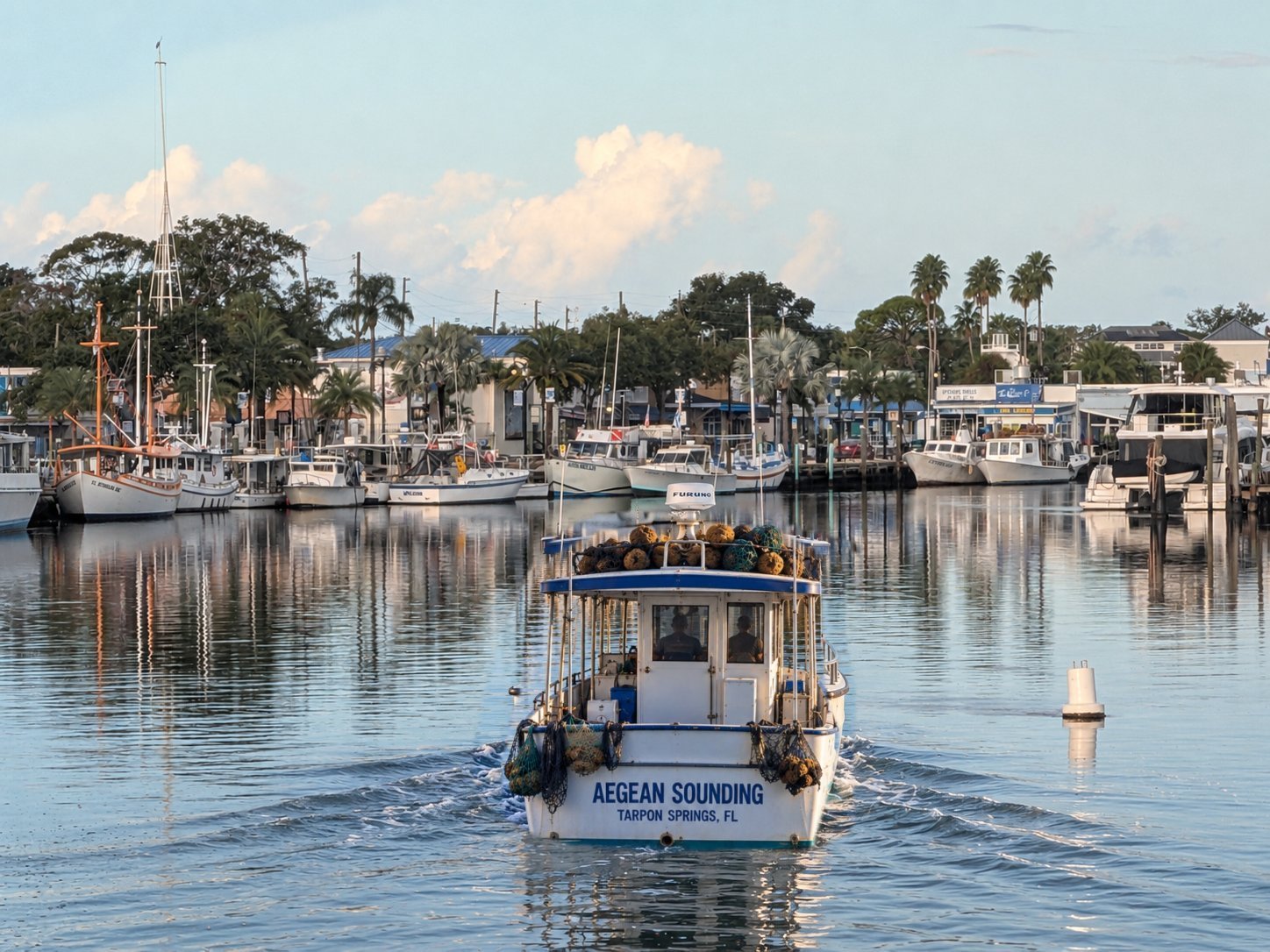
Then Gus caught sight of a boat coming upriver through the narrow stretch he could see from his seat.
As she drew closer, he recognized the familiar bow of Th e Sounding .
Gus stood, tossed his empty coffee cup, and walked west toward her empty slip.
As he moved along the dock, the diesel’s steady rumble reached him.
Gus could see Mike standing at the helm, looking ahead as he guided her upriver toward the docks.
Poyraz stood ready with the lines.
The Sounding approached her slip but did not enter it.
Mike took her far enough past the slip to turn around, then brought her back into position to back in stern-first.
Gus had chosen the berth years ago so the boat would rest with her bow facing downriver. Mike knew the approach.
The sound of the diesel changed.
Mike reduced speed, and the deep rumble settled lower. Then it rose briefly as he adjusted the throttle.
The boat began moving backward toward the slip.
Gus watched Mike bring the boat in against the wind and outgoing current.
Mike made another adjustment. The diesel's rumble deepened, then eased.
Poyraz had the lines ready. He watched the narrowing space as carefully as Mike did.
Gus shifted his gaze from the stern to the bow and back again.
She edged backward.
Mike worked her into position a little at a time.
The stern entered the berth.
Mike checked the movement with the engine, keeping control as the boat eased farther back.
Poyraz moved to the stern, line in hand.
The stern drew close to the dock.
He secured the stern line.
Gus watched the boat's movement change as the line took hold.
Mike continued easing The Sounding into position. The outgoing current helped hold her bow in line with the berth as Poyraz moved forward and secured the bow line.
Mike remained at the controls while Poyraz attended to the remaining mooring lines, including the spring lines that would help hold the boat in position along the dock.
Poyraz checked the stern and bow.
With the boat secure, Mike shifted into neutral and shut down the engine.
The engine fell silent.
Gus watched his boat settle against her lines.
Mike knew The Sounding. Poyraz knew his work. Gus had trusted them with the voyage, and they had brought her home.
Gus stayed where he was.