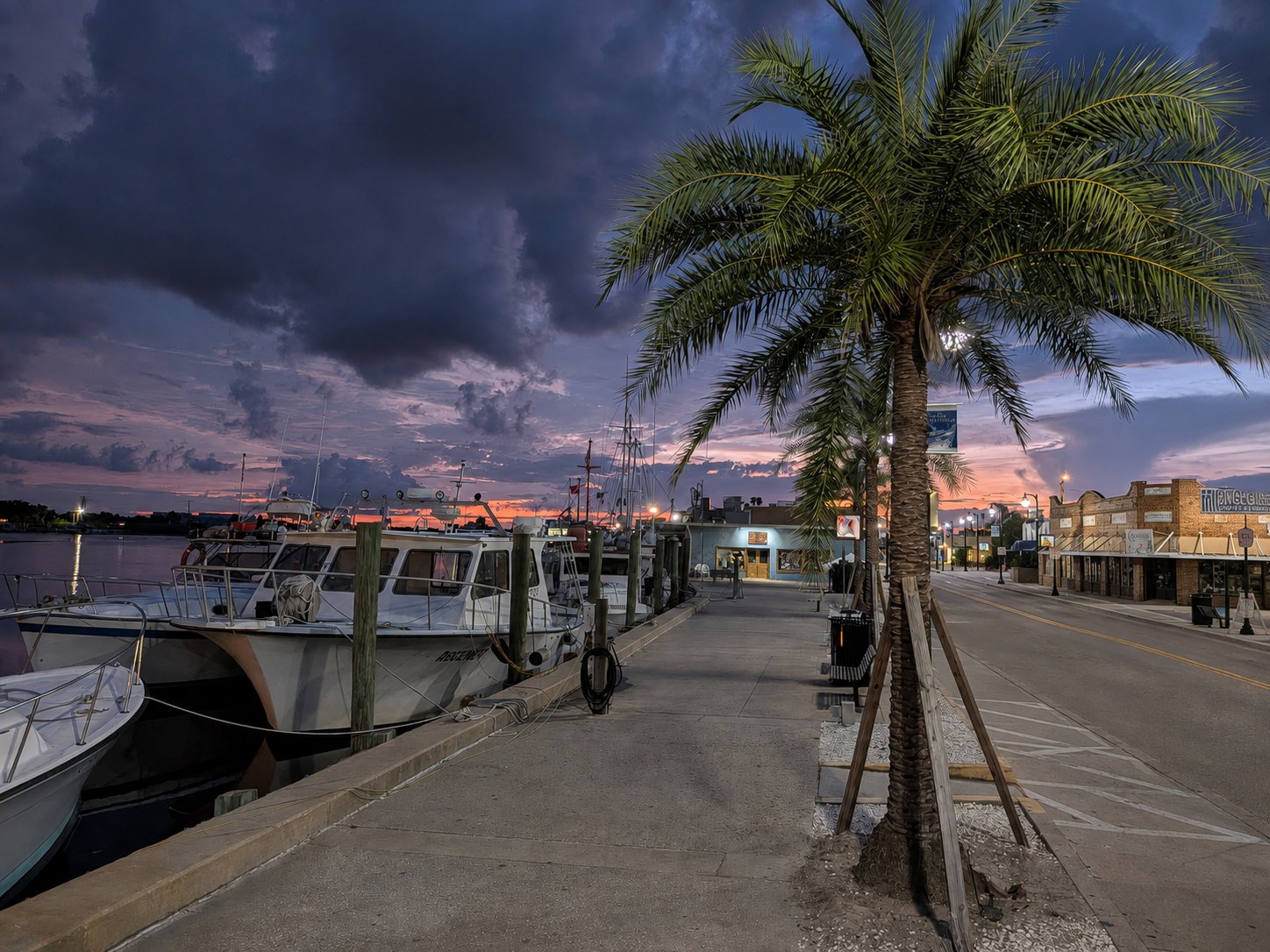
“Before the Docks Awaken” is a turning-point chapter from my forthcoming book
ARCemedes™ and the Moving River Bottom.
It offers a glimpse into the Anclote, its people, and a moment when something in the larger story begins to change. Here is a brief introduction that provides the context needed to enter this part of the larger story, which will be available in Spring of 2027.
Gus has spent most of his life on the Anclote River, much of it aboard the Aegean Sounding, the sponge boat that has carried him through decades of working water. His son, Kosta, runs the family restaurant there, while his nineteen-year-old grandson, Alexi, has begun exploring the river in a different way. From his kayak, Alexi has been taking measurements as he tries to determine whether an octopus he encountered—ARCemedes—could have survived so far inside the river system. As this chapter begins, Alexi’s search for proof has begun stirring questions in Gus about the river, the years behind him, and what may come after.
Movement One — Hope Street
Gus woke before four and looked at the clock.
3:34.
He closed his eyes again and shifted onto his other side. Maybe he could get another hour.
A while later he checked the clock again.
3:52.
Gus settled the pillow beneath his head and tried once more. He knew how this went.
The house was quiet. Nothing had awakened him that he could identify. No storm. No telephone. No sound outside that required him to get up.
Alexi had been talking about the river again the night before.
Another place. Another measurement. Another attempt to put what he'd seen beside what the meter had told him and make the two agree.
Gus had listened.
That was mostly what he had been doing lately.
Alexi would come back from the river with something—a number, a question, something somebody had told him, something that didn't fit what he thought he knew. Then he would turn it over and come at it from another direction.
At first Gus had been pleased by the persistence.
Now something about it bothered him.
Not because Alexi was measuring the water. Gus understood the desire to know conditions. A man working on water spent half his life trying to understand conditions.
It was what Alexi seemed to want the measurements to do for him.
Gus looked at the clock again.
He got up.
There was no particular reason to go to the Sponge Docks at four in the morning, except that The Sounding was there.
That bothered him too.
He pulled on a short-sleeved shirt and pants and stepped outside.
The day's heat had eased without cooling the air. Gus could feel the warmth of it on his bare forearms, but it was comfortable now. No jacket. No reason to hurry inside. Just the pleasantly warm night air and the quiet street.
The houses of the old Greek neighborhood stood quietly around him. Gus had walked past them for most of his life. He didn't think of the neighborhood as historic.
It was where people lived.
Hope Street descended gradually toward the Sponge Docks. Gus followed the slow decline.
Out there, beyond the river, far to the north, the clouds flashed.
Gus looked toward them.
There was no thunder.
For an instant, light from inside the clouds revealed their shape. Then it was gone, and the sky became dark again.
Gus kept walking.
At this hour he noticed the slope differently. There was no traffic to distract him, no voices, none of the ordinary movement that pulled his attention from one side of the street to the other.
He simply walked downhill toward the river.
At the bottom of Hope Street, Dodecanese Boulevard crossed in front of him.
Beyond it were the boats.
Gus crossed.
Movement Two — Past the Tour Boats
The Sponge Docks were not dark.
Streetlights ran along Dodecanese, illuminating pavement, palms, a couple of parked cars, and the fronts of buildings. Greek-heritage banners hung from the light poles. Restaurants and shops that would be busy later were closed.
Everything was recognizable.
Almost nothing was happening.
There was only the hum of some machine from behind the stores.
Gus turned and walked along the waterfront.
The tour boats came first.
They sat tied in their slips, empty and quiet.
Hours ahead, passengers would gather around them. Crews would come aboard. Engines would start. People would carry bags and drinks and wait to be taken out toward the Gulf for a dolphin watch and onto Anclote Key to collect shells.
Now the boats simply rested against their lines.
The benches along the street were empty. A car passed somewhere behind him. Then the street was quiet again.
The public Sponge Docks had not disappeared. All of it was still there—the tour boats, restaurants, shops, signs, lights.
But without the people, another part of the place was easier to see.
Gus kept walking.
The waterfront changed as he went.
Lines. Pilings. Rope. Railings. Equipment.
Gus continued east, passing between the bronze sponge diver, his helmet held against his chest, and the old sponge boat moored at the dock as a historic display.
He hardly looked at either.
They belonged to the docks as much as the pilings and boats did.
Boats fitted closely into working spaces. Some lay against the dock, with another boat tied alongside them, extending the working slips farther out into the river.
Extension cords and water hoses ran from the boats to the utility posts along the dock.
Ahead of him, something moved.
Movement Three — Thanos
It was Thanos.
He was moving quickly around one of the boats, looking beneath things and shifting whatever was in his way.
Thanos looked up.
“Gus?”
“What are you doing here?”
Gus stopped.
“Couldn't sleep.”
Thanos nodded as though that was enough of an explanation.
Gus looked at what he was doing.
“And you?”
“Trying to sleep below. It’s too hot. Even with the fan.”
He went back to searching.
Gus watched him lift something and put it down again.
“What'd you lose?”
“My cigarettes.”
Gus almost smiled.
Thanos checked another place.
“Need to find them so I can go back down, watch television and fall asleep.”
Gus couldn't think of anything useful to say to that.
“Wish you the best. Good night, my friend.”
Thanos waved without looking up.
Movement Four — Two Here, Two There
Gus turned away and sat on the bench.
Two sponge boats were directly in front of him.
He knew what was wrong with both.
Everyone who worked the sponge boats knew something about everyone else's business—who had gone out, who had come back, what had broken, what needed fixing, and which boat might not be going anywhere for a while.
The boat Thanos was sleeping aboard had given up its engine to be used somewhere else.
The other needed serious engine work. The owner and crew were waiting for a mechanic to come from Greece.
Gus knew what that meant.
A boat without an engine wasn't simply missing an engine. It meant work that couldn't be done. Money that had to be found. Decisions about repair, replacement, and time.
Gus sat there for a while.
In the distance, a vehicle crossed the Alt-19 bridge.
The sound carried over the river for a few seconds, then faded.
Quiet returned.
Gus wasn't looking for anything in particular. His eyes moved over the boats, the pilings, the lines disappearing into the dark water. Lights reflected from the hulls and stretched across the smooth surface.
No engines. No voices. Not even the sound of water against the boats.
For a moment, the ringing in Gus's ears was the loudest thing he could hear.
His eyes then focused directly across the river.
Something about that view held him.
Two large recreational boats sat on the opposite side.
Gus looked at the sponge boats in front of him, then across the water again.
Two disabled sponge boats here.
Two large pleasure boats there.
Barely two hundred feet separated them. Along one of the narrowest stretches of the working Anclote, Gus could take in all four at once.
Two here.
Two there.
The boats across the river sat higher and cleaner, built for a different purpose and a different relationship with the water.
Gus didn't resent them.
People went onto the Gulf for all kinds of reasons. They always had.
He looked back at the sponge boats.
An engine came out. A repair waited. A trip didn't happen. Someone found the money. Someone found another way.
Sometimes they didn't.
Far off, the clouds flashed again.
Gus looked toward them.
No thunder followed.
He sat there a little longer.
Then he got up and moved on toward The Aegean Sounding.
Movement Five — The Water
Before he reached The Aegean Sounding, Gus stopped beside the river.
From there, his view opened across the basin.
The marina lay on the opposite side, its boats and docks picked out by scattered lights. Beyond it, the Alt-19 bridge crossed the river, carrying the occasional vehicle Gus had been hearing in the distance.
Between him and all of it, the water was remarkably calm.
There was hardly a ripple on it.
Lights from the other side of the basin reached across the surface in long reflections, broken only around pilings and hulls.
Gus watched the river.
Without ripples, it was difficult to see the water moving at all.
But Gus knew it was.
The tide was somewhere between high and low, the river still moving even though its surface gave little sign of it.
He watched a reflection stretch down the surface.
It seemed almost fixed.
It wasn't.
Alexi had been trying to put numbers to this river.
Gus understood why.
The boy wanted the river to give him something solid enough to prove that what he'd seen could have been there.
Gus looked at the smooth water again.
Water was going somewhere.
Then he stepped aboard The Aegean Sounding.
Movement Six — The Interval
She was where she belonged.
That mattered.
The Aegean Sounding wasn't an exhibit and wasn't a memory Gus visited when he wanted to remember being younger.
She worked.
But she was more than work to Gus.
Stepping aboard her was as familiar as stepping through his own front door. He knew where everything belonged, where to put his hand, where the deck gave beneath his weight, the sounds that meant something and the ones that didn't.
He had eaten aboard her, slept aboard her, worked from her, worried aboard her, spent countless hours maintaining and repairing her, and brought her home again more times than he could count.
Other places held parts of his life.
The Aegean Sounding had carried it.
For the first time since waking, Gus felt no need to be anywhere else.
His body knew where to put his weight before he thought about it. That pleased him.
She still went to the sponge grounds. Men Gus trusted could take her out without him. Sometimes Gus went with them. Sometimes he didn't. He could still dive when he chose and when conditions were right.
The arrangement hadn't happened all at once.
Years had changed it.
So had Gus.
What Gus didn't know was what was to happen after him.
There were men now who knew the boat and knew the work. Gus trusted them.
But that wasn't the same thing.
Kosta had the restaurant.
Alexi had grown up working in the family restaurant and at times on the boats. He knew both worlds. But high school was behind him now, and Gus didn't know what the boy would choose.
Neither was waiting to take the sponge-diving business from his hands.
Gus had never asked them to. He had encouraged them to find safer work, work that paid better.
Still, at seventy-five, there were mornings when he wondered what happened to a lifetime of work when no one in the family was waiting to take it from you.
He checked things without deciding to check them.
A line. Something on deck. The position of equipment.
The thousand small things a person noticed because he had once seen what happened when somebody didn't.
Nothing required his attention.
Gus sat.
He rested his hands on his knees.
No insects buzzed at his ears or made him lift a hand to swat them away. Nothing crawled across his hand. The deck and the surfaces around him seemed just as undisturbed.
For a warm August night beside the river, he could simply sit.
Across the water, lights continued to stretch across the smooth surface.
A vehicle moved somewhere beyond the docks.
Then nothing.
The distant mechanical sound, like a motor behind the buildings, continued.
The flags on the boat hung nearly still.
Far away, light flashed inside the clouds.
Gus watched the darkness where it had been.
After a while, it happened again.
He waited for thunder.
None reached him.
The river remained smooth.
For a long time, nothing required Gus to do anything.
So he didn't.
Movement Seven — What Was Already There
For most of the time since Gus had come down Hope Street, nothing had changed.
The boats remained where they were. The river moved without appearing to move. The docks stayed quiet. Gus sat with his hands resting on his knees.
He had been there for hours now.
Somewhere along the way, the quiet had changed. He was no longer simply sitting in it.
He was waiting.
He wasn't sure for what.
Then a mourning dove called from somewhere nearby.
Coo-OOO… coo… coo… coo.
Gus lifted his head.
After so much quiet, the soft, familiar sound caught his attention.
He waited for it again.
Coo-OOO… coo… coo… coo.
Something in Gus lifted.
He sat a little straighter and listened.
A short time later, two crows flew overhead.
Caw. Caw. Caw.
One called, then the other.
Gus followed them with his eyes.
Then came the laughing gulls.
Ka-ha, ka-ha, ka-ha, ka-ha.
They crossed above the waterfront, their calls carrying over the river.
Then came the thin cry of an osprey.
Keee! Keee! Keee!
Gus looked toward the sound.
At first he couldn't see it.
Then the osprey came into view, flying east across the Anclote in front of him, toward the basin.
Gus watched it go.
One after another, each seemed to take its place in the morning's announcement.
Gus waited and watched, listening for what might come next.
The eastern sky was beginning to lighten.
Not sunrise yet.
But enough.
The artificial lights still burned along Dodecanese, only now they were no longer solely responsible for making the waterfront visible.
Edges appeared differently.
Boats separated more clearly from the water behind them.
Pilings that had been shapes in the darkness became wood, rope, barnacles, shadow.
And birds.
Gus looked across the river.
One sat on a piling.
Then he noticed another.
Farther down, another.
Along the rows across the water, birds occupied one piling top after another.
Across the river, blackbirds lined the wire, their sharp, raspy calls joining in a noisy chorus.
Gus looked from the pilings to the wire.
He hadn't seen them come.
Maybe they had been there all along.
Maybe they hadn't.
The waterfront had seemed almost empty when he came down Hope Street.
It wasn't.
Another vehicle came down Dodecanese.
The first one Gus had heard earlier had seemed almost out of place.
This one didn't.
Another followed. A step van appeared. Somewhere, a door opened. Walkers passed, talking quietly with each other.
On the storefront side of Dodecanese, a man walked alone with earbuds in, listening to something only he could hear.
A Tarpon Springs police vehicle moved slowly along Dodecanese, making its morning pass.
A city worker passed in a 4-by-4 and continued toward the west end of the docks by the tour boats, where he stopped to pick up a few things.
Another person appeared farther down the waterfront, coming from the east.
The flags moved a little more.
The river's surface began to lose some of its earlier smoothness.
Across the river, the clouds were there now.
In the growing light, Gus could see their height and their edges. They were the same clouds that had revealed themselves only for an instant whenever lightning flashed inside them.
Gus looked across the river toward them.
Another flash came.
This time the clouds didn't disappear afterward.
They remained.
Then Gus looked upriver toward the estuary.
The sun was coming up beneath the clouds.
They stretched across the sky, black against the growing light. Beneath them, the horizon burned orange and pink, the colors brighter against the darkness above.
The light reached across the water between the boats and pilings.
Gus stood there looking at it.
Along the docks, boats remained tied to their lines.
Ahead of him, the Anclote opened toward the estuary beneath the dark clouds and the brightening sky.
For a while, he simply watched.
Then his attention returned to the Sponge Docks.
The street parking spots were still empty. The restaurants were still closed. The benches were unoccupied. The tourists hadn't arrived.
Local people were already moving along Dodecanese.
Others were beginning their work.
The Sponge Docks hadn't awakened yet.
The Anclote had never been asleep.
Movement Eight— The Question
Alexi came back into his thoughts.
The boy had gone onto the river because somebody had told him the octopus couldn't have been where he said it was.
The water was too brackish.
Alexi could have argued.
Instead, he went looking.
He had measured instead of insisting.
At Whitcomb Bayou, he had been willing to consider that what he thought he'd seen might not have been ARCemedes at all.
Then he had gone farther.
Hickory Point bothered Alexi most.
He knew what he had seen there.
But the water he'd measured there hadn't given him the difference he expected.
Alexi knew what he had seen. He knew what he had measured.
And one wasn't explaining the other.
Alexi wasn't short of effort.
He wasn't short of measurements either.
Still, he kept returning.
Gus looked down at his hands.
Then at the deck beneath his feet.
He thought about all the years it had taken him to know when an engine sounded wrong.
All the times he had returned to the same bottom. The weather he had watched. The mistakes. The things other men had shown him.
The things nobody could have shown him because he had needed years to see them for himself.
Then he thought about Alexi going back to the river.
Again.
And again.
Gus looked across the water.
He didn't know what to make of that yet.
But something about the boy's persistence looked different to him now.
Maybe another measurement wasn't what Alexi needed.
The question that had been bothering Gus all night became simpler.
What are you trying to prove?
Gus didn't know how Alexi would answer.
Maybe Alexi didn't know either.
That was all right.
The question was enough.
Movement Nine— Back Up Hope Street
Gus stayed aboard The Aegean Sounding a while longer.
The eastern sky had brightened.
The sun was close now, just below the horizon.
For the first time, the distant clouds no longer needed lightning to reveal themselves.
Gus could see them.
Along Dodecanese, a modest line of cars was coming toward him.
Not traffic yet.
Just one car behind another, enough to tell him the day was beginning.
Gus stood.
Before stepping ashore, he looked once around The Aegean Sounding.
Nothing aboard required him.
For some reason, that didn't feel quite the same as it had when he arrived.
He stepped onto the dock and walked west.
The two disabled boats fell behind him.
Gus stopped and looked back.
The working waterfront stretched away behind him. Boats rested along the river. Dodecanese ran beside them, still mostly empty. A palm rose above the walkway, its fronds against the dark clouds.
Farther east, morning had opened beneath them. Orange and pink light showed along the horizon while the clouds still held most of the sky.
Then he turned west again and continued toward the bronze sponge diver.
Gus looked at the boats, the empty street, the river beyond them.
He knew this view.
But he had never seen it quite this way.
He stood there another moment.
Ahead were the tour boats he had passed hours earlier, still tied in their slips.
The parking lot in front of them was still empty.
No tourists yet.
The restaurants were not yet open.
Gus kept walking.
When he reached Hope Street, he crossed Dodecanese and turned toward home.
The gradual slope he had followed down in darkness now rose ahead of him in the growing morning light.
The air was still comfortable against his bare arms, though the coming August day was already somewhere inside it.
He started uphill.
Alexi's measurements still didn't explain what Alexi believed he had seen.
Gus couldn't explain it either.
Gus thought about the work he had carried for most of his life, and what would happen when it was no longer his to carry.
He still didn't know.
Kosta had his own life.
Alexi would have his.
Gus had never asked either of them to become him.
In many ways, that was what he had wanted for them.
But as he climbed Hope Street, the future did not seem quite as empty as it had when he walked down.
He couldn't have said exactly why.
Not yet.
He did know what he wanted to ask Alexi.
What are you trying to prove?
Gus continued uphill toward home.
Behind him, the Sponge Docks were beginning another day.