
Put Your John Hancock on It
A signature is where authorship becomes accountability.
Author’s Note on the Cover Image (See PDF)
The cover image depicts an oversized John Hancock signature constructed from the kinds of help writers actually encounter while making a piece, including editorial comments, research notes, beta reader feedback, copyediting, fact-checking, spell-check corrections, and AI prompts. The image is not meant to excuse assistance. It asks what remains the writer’s after assistance has done its part. The help can be seen, but the signature still belongs to one person. The image reflects the essay’s central recognition: The issue is not whether tools were absent. It is whether the person named on the work can honestly claim it.
Abstract
The debate surrounding AI-assisted writing often begins with a question that matters, but does not go far enough: Did AI help create this work?
There is a harder question underneath it. As AI becomes part of the writing environment, what allows the author to claim it as their own?
This essay explores the familiar expression “Put your John Hancock on it” as a way of examining who owns the work, who answers for it, and why readers should trust it. It argues that the future of authorship may depend less on proving that assistance was absent and more on whether the person named on the work can still claim it, explain it, and stand behind it.
What We Mean When We Say It
Few people have signed anything as consequential as the Declaration of Independence.
Most people have never read the entire Declaration of Independence.
Yet almost everyone understands the phrase:
“Put your John Hancock on it.”
The phrase survived because people still know what it asks of them. We do not use it merely to mean “sign here.” We use it to mean:
Put your name behind it.
A signature is not simply handwriting.
It is a public claim.
It says:
- This belongs to me.
- I stand behind it.
- I accept responsibility for it.
That is the weight a signature carries, and the weight authorship inherits.
The Famous Signature
There is a small irony behind the expression.
John Hancock did not write the Declaration of Independence. The document passed through drafting, revision, debate, and approval before it became final. More than one person shaped it before it was signed.
Yet history remembers Hancock’s signature.
He is not remembered for writing every word or for working outside the process. History remembers the signature because it was impossible to ignore.
His name became a visible act of accountability.
The contributions of others remained part of the document. The signature made clear who accepted responsibility for it.
That distinction matters again.
The Declaration was collaborative, but the act of standing behind it remained personal.
The Wrong Question
Much of the AI-writing debate keeps returning to one question:
Did AI touch this?
The question is reasonable. Readers, publishers, and writers all have something at stake. Readers want authenticity. Publishers have trust to protect. Writers want recognition for what they actually made.
But the question quickly becomes difficult.
What kind of assistance are we actually talking about?
- Research assistance?
- Fact checking?
- Editing?
- Brainstorming?
- Structural suggestions?
- Proofreading?
The closer we look at real writing practices, the harder the line becomes to draw.
Writers have long used assistance. Editors shape manuscripts. Beta readers identify confusion. Researchers gather information. Proofreaders find mistakes. Dictionaries clarify meaning. Spellcheck corrects errors.
Few readers would argue that these forms of assistance automatically destroy authorship.
AI does not invent assistance, but it can reach further into the writing process than earlier tools did.
That is where the argument usually hardens into two camps.
The Purists and the Delegators
One response comes from writers who want a hard boundary.
Their concern deserves respect. They are not simply protecting words. They are protecting the slow work of craft: voice, struggle, and discovery. They are protecting the slow work by which writers find out what they mean. Their fear is understandable:
If AI begins supplying too much of the language, where does the author end and the machine begin?
Others treat AI assistance as if it can keep taking on more of the work without changing what the author’s name represents.
That raises a different concern.
If enough responsibility is delegated, what exactly does the author’s name still represent?
The purists see what can be lost. The delegators show how thin authorship becomes when responsibility has been handed away. Neither position is enough.
A signature is not simply handwriting.
It is a public claim.
A Signature Is Not About Purity
The debate often treats assistance as contamination.
Under that standard, authenticity requires:
No assistance, no influence, no collaboration, no tools.
But that has rarely been true. Writing has almost always involved help.
An author can use:
- editors,
- beta readers,
- research assistants,
- dictionaries,
- archives,
- spellcheck,
- AI research tools,
and still sign the work honestly.
The presence of help is not enough to settle the question. The real question begins after assistance, with what the author can still answer for.
Did the work still carry the author’s:
- voice,
- judgment,
- meaning,
- validation,
- accountability?
If the work still carries those things, the signature still means the author can stand behind it.
Purity is the wrong standard. Responsibility is the one a signature requires.
Why Publishers Care
Publishers are often portrayed as resisting AI.
That may be true in some cases.
But underneath that resistance is a concern about trust.
A publisher’s reputation depends upon the meaning of the names appearing on its covers.
Readers are not only buying pages of language. They are relying on a name.
They expect the author’s voice to be present, the author’s judgment to have shaped the work, and someone to remain accountable for what was written.
AI not only makes text easier to produce. It makes the path of the work harder to see.
Readers want to know how much of the work still carries the author’s voice and judgment.
Publishers want to know who can answer for what appears on the page.
A tool label cannot settle that question. Someone named on the work has to be able to stand behind it.
Purity is the wrong standard.
Responsibility is the one a signature requires.
More Writing, More Claims of Authorship
AI will not disappear from writing. The opposite is happening: it is becoming part of the writing process.
As barriers to creating, organizing, editing, and publishing text continue to fall, more people are bringing written work into public view. More books are appearing. More articles are being published. More people are claiming authorship.
Some will welcome that. Others will worry about what it means. Both responses may be right.
But the larger reality remains: the future is unlikely to be defined by proving that no AI was involved. That standard may already be fading.
The future may depend instead on whether authorship remains visible enough to be trusted and accountable enough to be claimed.
Not because readers demand perfection.
Because readers need someone to stand behind the work.
A Third Position
This is where a third position becomes necessary.
The answer is not to reject AI or surrender authorship to it. The answer is governance.
Governance is not a standard applied after the work is finished. It happens while the work is being made.
It is the author reading a suggested sentence and knowing it sounds too smooth. It is deleting the paragraph that says the right thing in the wrong voice. It is checking the date before keeping the historical detail. It is refusing the clever phrase that does not belong. It is asking whether the work still sounds like something the author would say, defend, and sign.
The principle is simple:
AI may assist the work.
The author must still govern the work.
That distinction matters.
A tool can assist, but it cannot decide what the author means. A suggestion may enter the process, but judgment still belongs to the person signing the work. Generation can produce language, but it cannot carry responsibility.
The role of the author does not disappear because a tool becomes capable. Assistance does not diminish the author’s responsibility. It makes judgment more important.
AI may assist the work.
The author must still govern the work.
What the Signature Promises
A signature has always done more than identify a person.
It identifies responsibility.
When an author places a name on a book, article, essay, or report, the author makes a promise.
Not that the work is perfect, but that the author owns it.
The signature tells readers:
- These are the ideas I am willing to defend.
- These are the conclusions I am willing to explain.
- This is the work I am willing to claim.
That promise matters whether the assistance came from an editor, a researcher, a proofreader, or an AI system.
Trust is not created by proving assistance was absent. It is created when the author can still defend, explain, and claim the work.
Why Signatures Exist
Signatures tend to appear where responsibility must be attached to a specific person: on contracts, checks, prescriptions, mortgages, legal filings, permission forms, and declarations. The signature does not mean the signer produced every word alone. It means the signer is willing to be identified with the result.
That is why signatures matter in authorship.
The name on the cover is not only a label. It is where the reader’s trust meets the author’s responsibility.
In an AI-assisted world, this becomes even more important. The issue is not whether tools helped shape the process. It is whether the person named on the work can honestly stand behind the result.
What John Hancock Still Teaches
John Hancock did not become a symbol because he wrote every word.
He became a symbol because his signature made responsibility impossible to miss.
That may be the lesson that matters now.
The Declaration was not authentic because it was signed by only one person. It carried authority because identifiable people were willing to stand behind it publicly.
The signature made accountability visible.
Perhaps the future of authorship depends on the same principle.
Not proving that no tool participated.
Not pretending assistance never occurred.
But making clear who remains willing to put a name behind the work.
The debate is not ultimately between authors who use AI and authors who do not. It is between names that still carry responsibility and names that claim more than they can support.
And that may be the question worth asking whenever a name appears on a cover, beneath an article, or at the end of an essay:
If you put your John Hancock on it, what exactly are you promising?
Closing Note from Ed Woods
The questions raised in this essay are no longer theoretical. Authors, publishers, educators, and readers are already facing them as AI-assisted work becomes more common.
The challenge is not simply determining whether AI was involved. The challenge is preserving trust when assistance, authorship, and accountability become harder to separate.
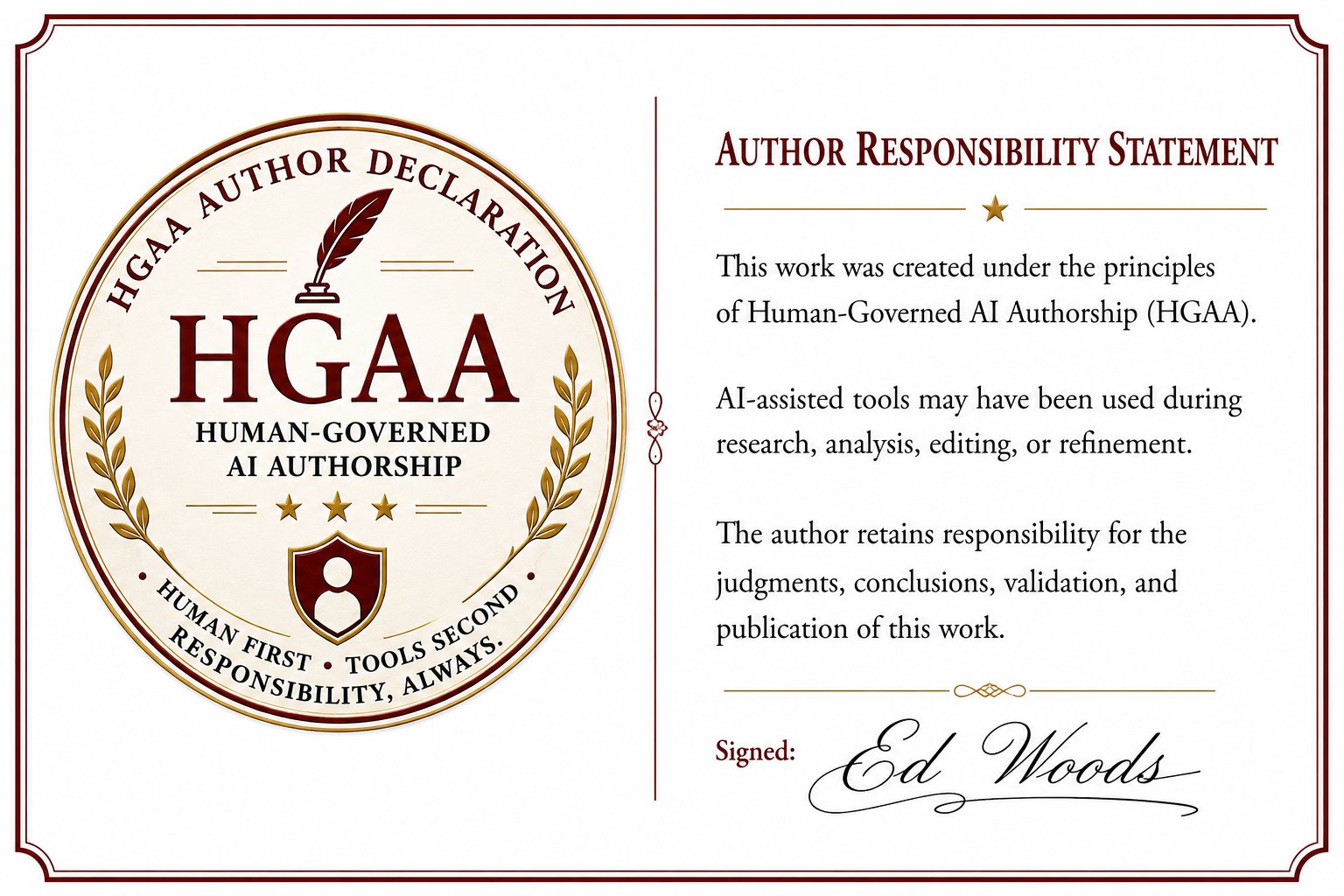
Human-Governed AI Authorship (HGAA) was developed to address that challenge by making authorship, validation, responsibility, and accountability more visible.
CraftAuthors.com extends those principles to creative writers who want to use AI without surrendering voice, judgment, imagination, or ownership.
The essay stands on its own. The frameworks are one attempt to meet a problem that is already here.
Author’s Governance Note
This essay was developed through AI-assisted drafting and deliberate human review, guided by the ARC Framework, the principles of Human-Governed AI Authorship, and the craft discipline described in Craft Authorship.
AI assisted with drafting, revision, and review. It did not determine authorship or make final decisions.
I am the author of this essay because I exercised judgment over what was proposed, rejected what did not belong, accepted only what reflected my intent, and accept responsibility for the final work.
Governance References
Read more Measured Resonance essays at:
ReefFlowEssays.com
What do you think?
If this made something clearer for you, share it with someone who is already using AI but has not named this tension yet. Where do you draw the line between AI assistance and authorship?
Share on Facebook